119. The Friday build
Friday of week twenty-three. On Oskar's sheet one line is still open: Export the whole family to a dated folder every Friday.
Mira has every piece of it. ship_check.py says whether the font may go. export_family.py says whether ten files arrived. inspect_export.py reads them. Two scripts write proofs. bump_version.py gives the font its next number. Six scripts, and on a Friday afternoon she is the one who has to remember them, in order, and not carry on when one of them says no.
Remembering an order is work for a script. Today you write the one that calls the others.
What you need
Plum-practiceopen in FontLab 9 and saved, with Fly installed.- The scripts from chapters 97, 112, 114, 115, 116 and 118.
I couldn't run the code in FontLab 9. I ran today's script and the six it calls in plain Python, with stand-ins for FontLab and with font files I built myself, through a whole Friday: a refusal, a first half, an export and a second half. Every block of output below comes from those runs.
Step 1: A build has a hole in the middle
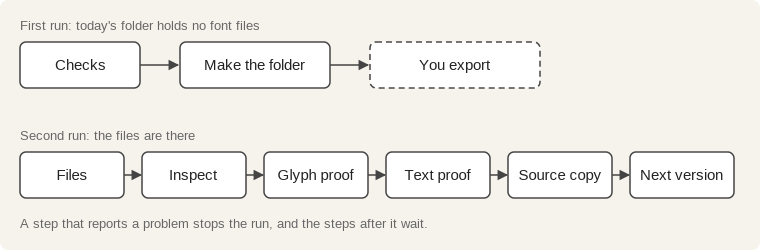
Nothing I've found lets a script press Export Font As with settings I can vouch for. Chapter 111 said so and nothing has changed. So the build can't be one run. It's two, with you in between:
- Check the font. Make today's folder. Stop.
- You export.
- Check the files, inspect them, write the proofs, keep a copy of the source, give the font its next number.
One script can do both halves if it can tell which one is due. It can, from the disk: if today's folder for this version holds no font files, it's the first half. If it holds some, the export has happened, and it's the second.
That's a better signal than a setting at the top of the script, because nobody has to remember to change it.
Step 2: Teach six scripts to answer
Each of the six ends by printing. ship_check.py prints Not ready. and you read it and stop. A script that calls ship_check can't read. Printing tells a person. To tell another script, a function has to return something.
So make the same three changes to each of the six.
First, move it out of the Scripts folder to the site-packages folder where Fly lives, as chapter 114 did with preflight.py, so it can be imported.
Second, change its last line from main() to chapter 114's guard, so that importing it doesn't run it:
if __name__ == "__main__":
    main()
Third, add one line at the very end of its main, after the last print, indented four spaces so that it belongs to main and to nothing inside it:
| Script | Last line of main |
|---|---|
ship_check.py |
return total + broken |
export_family.py |
return missing |
inspect_export.py |
return problems |
proof_html.py |
return 0 |
proof_text.py |
return 0 |
bump_version.py |
return 0 |
The rule is the same for all six: main returns the number of things wrong, and 0 means go on. In inspect_export.py the return goes after the if shown is not None: block and not inside it.
Each of those main functions also has early exits, a bare return after "Open a font first." and the like. Leave them. A bare return gives back None, and you'll see in a minute why that's the right answer for them.
Once a script has moved, it's no longer in the Scripts menu. To run one alone, type two lines in the Scripting panel: import proof_text, then proof_text.main().
Step 3: The mistake
Mira's first build called the steps in a loop and wrote down what each said:
def run_steps(steps):
    for label, step in steps:
        result = step()
        log(f"{label}: {result}")
She tried it on a folder where one file hadn't arrived, the Medium TTF:
>> Second half, for 2026-12-18-v1.003
  MISSING  GG Plum Medium .ttf
10 wanted, 9 there, 1 missing.
>> Files: 1
5 files, 0 problems.
Features in the last file: cpsp dnom frac kern liga numr smcp ss01 zero
>> Inspect: 0
Proof of otf/GGPlum-Regular.otf
235 glyphs with a character, 39 without.
Wrote /Users/mira/Halfmoon/exports/2026-12-18-v1.003/proof-glyphs.html
>> Glyph proof: 0
5 styles, 45 lines of text.
Wrote /Users/mira/Halfmoon/exports/2026-12-18-v1.003/proof-text.html
>> Text proof: 0
>> Source copy: 0
Version 1.003 -> Version 1.004
Note line for 3 masters: 2026-12-18: Version 1.004
6 fields changed.
>> Next version: 0
>> Build finished.
The second line says a file is missing. The fourth records it: Files: 1. And then the build carried on, wrote proofs into an incomplete folder, and gave the font its next number, which marks 1.003 as shipped. Build finished. is the last thing on the screen, and on a Friday afternoon the last line is the one that gets read.
She had made the steps answer and then not listened. A build has to stop at the first answer that isn't 0:
def run_steps(steps):
    for label, step in steps:
        result = step()
        if result != 0:
            log(f"{label}: stopped the build ({result})")
            return False
        log(f"{label}: ok")
    return True
run_steps now answers too: True when every step passed, False when one stopped it.
The test is != 0, not > 0, on purpose. A step that left through one of its early exits returns None. None isn't 0, so the build stops there too. A step that didn't say how it went is treated as one that went badly.
The whole script
#FLM: Friday Build
# Run it twice. The first run checks the font and makes today's folder.
# You export. The second run checks the files, writes the proofs, keeps
# a copy of the source and gives the font its next version number.
import shutil
from datetime import datetime
from pathlib import Path

import bump_version
import export_family
import fly.ap.core.scripting as scripting
import inspect_export
import proof_html
import proof_text
import ship_check
from fly import fl, qt
from fly.ap.ui.dialogs import run_standard_message_box

TITLE = "Halfmoon"


# Chapter 39's tell, written out again so this script runs by itself.
def tell(text):
    box = qt.QtGui.QMessageBox
    run_standard_message_box(qt, fl.MainWindow(), TITLE, text, "Information", box.Ok)


LOG = []


def log(line):
    stamped = f"{datetime.now():%Y-%m-%d %H:%M} {line}"
    LOG.append(stamped)
    print(">>", line)


def keep_source():
    font = fl.CurrentFont()
    folder = export_family.export_folder(font, scripting.current_package())
    shutil.copy(font.path, folder / Path(font.path).name)
    return 0


BEFORE = [("Checks", ship_check.main)]
AFTER = [
    ("Files", export_family.main),
    ("Inspect", inspect_export.main),
    ("Glyph proof", proof_html.main),
    ("Text proof", proof_text.main),
    ("Source copy", keep_source),
    ("Next version", bump_version.main),
]


def run_steps(steps):
    for label, step in steps:
        try:
            result = step()
        except Exception as problem:
            log(f"{label}: DID NOT RUN: {type(problem).__name__}: {problem}")
            return False
        if result != 0:
            log(f"{label}: stopped the build ({result})")
            return False
        log(f"{label}: ok")
    return True


def font_files(folder):
    return [p for p in folder.rglob("*") if p.suffix.lower() in export_family.FORMATS]


def build(font, package):
    folder = export_family.export_folder(font, package)
    if not folder.exists() or not font_files(folder):
        log(f"First half, for {folder.name}")
        if not run_steps(BEFORE):
            return
        folder.mkdir(parents=True, exist_ok=True)
        log("Folder made. Waiting for the export.")
        print("Save the font. Then File > Export Font As, with chapter 112's")
        print(f"settings, into {folder}")
        print("Then run this script again.")
        return
    log(f"Second half, for {folder.name}")
    bump_version.DRY_RUN = False
    try:
        finished = run_steps(AFTER)
    finally:
        bump_version.DRY_RUN = True
    if finished:
        log("Build finished.")
        print("The font has its next number. Save it.")


def main():
    font = fl.CurrentFont()
    if font is None or not font.path:
        tell("Open a saved font first.")
        return
    exports = Path(font.path).parent / "exports"
    exports.mkdir(exist_ok=True)
    try:
        build(font, scripting.current_package())
    finally:
        with open(exports / "build-log.txt", "a", encoding="utf-8") as f:
            f.write("\n".join(LOG) + "\n")


main()
Save it as friday_build.py in the Scripts folder. This one you run yourself, so it ends in a plain main().
Notes on the listing, before the runs.
BEFORE and AFTER are lists of pairs, a label and a function. ship_check.main has no brackets after it. With brackets Python would call it on the spot, while the list is being made. Without them the list holds the function itself, to be called later by step(). Chapter 100's CHECKS worked the same way.
log does two things with one line. It prints it with >> in front, so the build's own lines stand out from what the six scripts print. And it keeps it in LOG with the date and time. datetime.now() is the moment it's called, and the part after the colon in the braces is a pattern for writing it: %Y the year, %m the month, %d the day, %H and %M the hour and minute.
main writes LOG to build-log.txt in a finally block, chapter 95's, so the file gets its lines when the build stops early and when something crashes. The "a" where you've always written "w" means append: add to the end of the file and keep what's there. A log that started fresh each run would lose the run that went wrong.
bump_version.DRY_RUN = False reaches into another module and sets its variable. The setting lasts as long as FontLab stays open, because a module is loaded once and kept. So the build puts the True back in a finally, whether the steps passed, stopped or crashed, and bump_version.main() run on its own afterwards still only rehearses. The build is the one place that has earned the real thing, since by that line everything else has passed.
keep_source does what chapter 117 asked for: a copy of the font file goes in beside the exports, so next month there's an old font to compare with. It copies the file as last saved. A script can't see changes you haven't saved, which is why the first half ends by telling you to save.
Python has a module called logging that does what log does and much more. I haven't seen how it behaves inside FontLab, where the screen it writes to isn't an ordinary one, so the book uses a few lines it can explain.
A Friday, run by run
The font is at 1.002. Run the build:
>> First half, for 2026-12-18-v1.002
Glyph names   274 looked at   ok
Unicode       235 looked at   ok
Features       35 looked at   ok
Font Info       5 looked at   ok
Metrics         8 looked at   ok
Masters       201 looked at   ok
Figures        10 looked at   ok
Kerning       105 looked at   ok
New version     1 looked at   1 problems
    2026-12-10-v1.002 already holds files
9 checks, 1 problems, 0 did not run.
Not ready.
>> Checks: stopped the build (1)
It stopped at its first step, and it was right to. Version 1.002 went to the publisher last week. Mira runs bump_version.main() by hand, with DRY_RUN off, for the last time. Then the build again:
>> First half, for 2026-12-18-v1.003
followed by nine lines of ok, and:
9 checks, 0 problems, 0 did not run.
Ready to export.
>> Checks: ok
>> Folder made. Waiting for the export.
Save the font. Then File > Export Font As, with chapter 112's
settings, into /Users/mira/Halfmoon/exports/2026-12-18-v1.003
Then run this script again.
She saves, exports, and runs it a third time. The folder holds font files now, so the script takes the other road:
>> Second half, for 2026-12-18-v1.003
  ok       otf/GGPlum-Light.otf
and nine more of those, then:
10 wanted, 10 there, 0 missing.
>> Files: ok
Then the five lines of inspect_export.py and >> Inspect: ok, the two proofs with an ok each, and the end:
>> Source copy: ok
Version 1.003 -> Version 1.004
Note line for 3 masters: 2026-12-18: Version 1.004
6 fields changed.
>> Next version: ok
>> Build finished.
The font has its next number. Save it.
The folder holds otf, ttf, Plum-practice.vfj and two proof pages. And build-log.txt, one level up, holds the day:
2026-12-18 15:40 First half, for 2026-12-18-v1.002
2026-12-18 15:40 Checks: stopped the build (1)
2026-12-18 15:40 First half, for 2026-12-18-v1.003
2026-12-18 15:40 Checks: ok
2026-12-18 15:40 Folder made. Waiting for the export.
2026-12-18 16:05 Second half, for 2026-12-18-v1.003
2026-12-18 16:05 Files: ok
2026-12-18 16:05 Inspect: ok
2026-12-18 16:05 Glyph proof: ok
2026-12-18 16:05 Text proof: ok
2026-12-18 16:05 Source copy: ok
2026-12-18 16:05 Next version: ok
2026-12-18 16:05 Build finished.
The times are my stand-in's. The counts are the reader's font as the book has built it, and yours will be your own.
The bump comes last, and that changes what the number on the font means. From today the font on the desk is always one number ahead of the last one shipped. Work done on Monday is done on 1.004, and next Friday's first run passes the version check with nobody thinking about it. Chapter 97 said the Friday build would call the bump. This is the call.
The second half doesn't run the checks again. It can't: the New version check would find today's own files and refuse.
Oskar takes the sheet off the wall and draws the eleventh line. He doesn't put it back.
Break it on purpose
Take return missing out of export_family.py again and run the second half on a complete folder:
10 wanted, 10 there, 0 missing.
>> Files: stopped the build (None)
Ten of ten, and the build stopped. main reached its end without a return, gave back None, and the build won't take silence for a yes. It's a nuisance and it's the right way round. The other way, a step you forgot to finish would pass every Friday. Put the line back. Because the module is already loaded, FontLab keeps the old one until you restart or use chapter 33's importlib.reload.
Now, in AFTER, misspell a function: proof_html.mian. Run:
AttributeError: module 'proof_html' has no attribute 'mian'
as the last line of a traceback, before any step ran. The list is built when the script is read, so a wrong name there fails at once. That's the good kind of failure. An error inside a step, while it runs, is caught by run_steps and becomes a DID NOT RUN line in the log, and the build stops there.
What you learned
A function that prints tells a person and a function that returns tells a script, so a script that others will call needs a return with a meaning, and here it's the number of problems. A build is a list of labelled functions run in order that stops at the first answer other than 0, and treats no answer as a bad one. What can't be scripted, the export, sits between two runs, and the script decides which half is due from what's on the disk. A log file opened with "a" and written in finally keeps the record of the runs that failed, which are the ones you'll want to read.
Try it yourself
- The second half is chosen by today's date in the folder name. Start a build at five to midnight, export after midnight, and say what the next run does. Then say what you'd do about it by hand.
- Add a step after "Source copy" that calls chapter 117's
font_diffwhen a second font is open, and returns 0 either way. - Run the build a fourth time, after
Build finished.What does it make, and is it harmful?
Next
Five weights are in the folder. The art director asked for nine, and chapter 107 said four of them lie outside what three masters can reach. Chapter 120 closes Part 6 with a release list written as code, and with an honest count of what shipped.